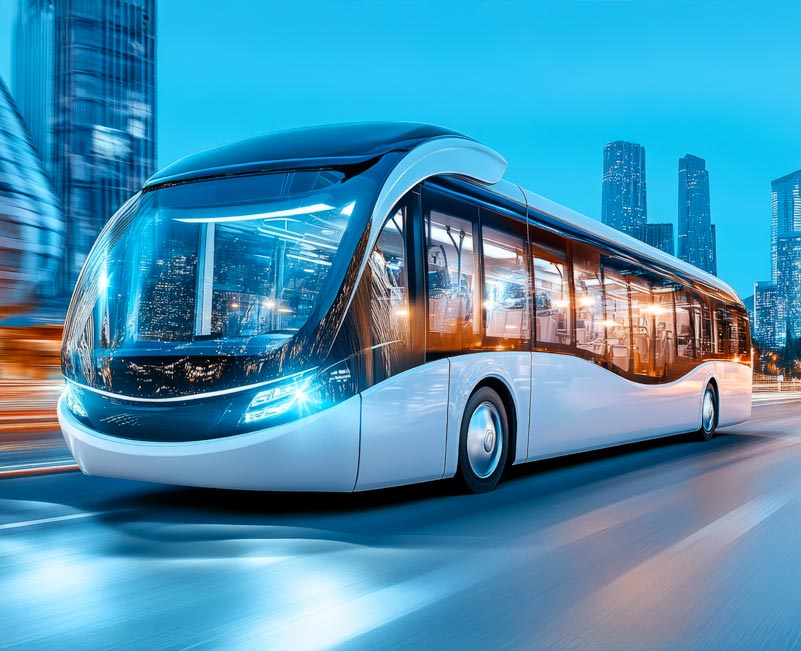
Electric buses have become a cornerstone of modern public transport systems.
Transit agencies and fleet operators are progressively replacing diesel fleets with battery electric buses (BEV) to reduce emissions, noise, and total cost of ownership.
Alongside these, other electrified vehicles are emerging, such as electric trucks for logistics, refuse collection vehicles, and urban service trucks.
Electric buses generally operate on fixed routes with predictable schedules. Fleets may include standard city buses, articulated buses, electric shuttles, and other public transit vehicles.
A robust electric bus charging station infrastructure is the key element to ensuring vehicle uptime, battery longevity, and energy efficiency.
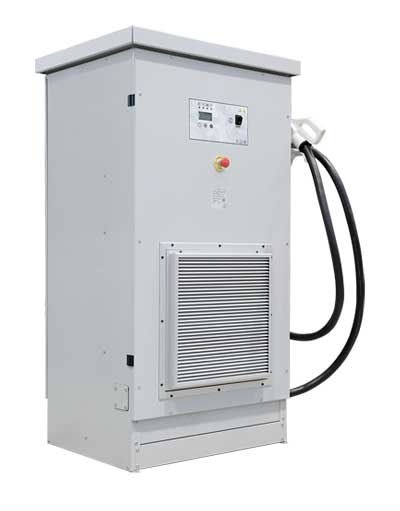
GEBAT designs and manufactures charging systems for electric vehicles and heavy-duty fleets with high-capacity batteries, based on standard automotive interfaces.
We support the CCS (Combined Charging System) standard, available as CCS1 for North America and CCS2 for Europe, as well as NACS (Tesla), MCS (Megawatt Charging System), and GB/T.
Furthermore, GEBAT produces ultra-fast charging equipment for integration into OppCharge pantograph systems, including Top-Down (Inverted Pantograph) or Bottom-Up configurations. The primary communication protocol used for these applications is ISO 15118 (Plug & Charge), though GEBAT also implements CANBUS-based protocols and proprietary solutions to meet specific OEM requirements.
The standard GEBAT HVS series, covered by CE certification for Europe and UL/CSA for the USA/Canada, supports battery voltages up to 800 VDC and 120 kW.
Through modular configurations of multiple HVS units and the use of liquid-cooled cables, charging power can be scaled to meet MCS (Megawatt Charging System) limits, specifically:
- Theoretical Maximum Power: 3.75 MW (3750 kW)
- Maximum Voltage: 1250 V
- Maximum Current: 3000 A